.png)
How One CEO’s Leadership Style Nearly Destroyed a $47 billion dollar company

What is WeWork?
WeWork is a company that provides shared workspaces, office services, and community experiences for businesses of all sizes. Founded in 2010 in New York City by Adam Neumann and Miguel McKelvey, WeWork quickly became known for its stylish office designs, flexible leasing options, and a culture-focused approach to work.
By 2019, WeWork operated hundreds of locations worldwide, with millions of members, making it one of the most successful startups in the world. At its peak, WeWork operated in over 120 cities across more than 30 countries which highlights the speed and scale of its global expansion.
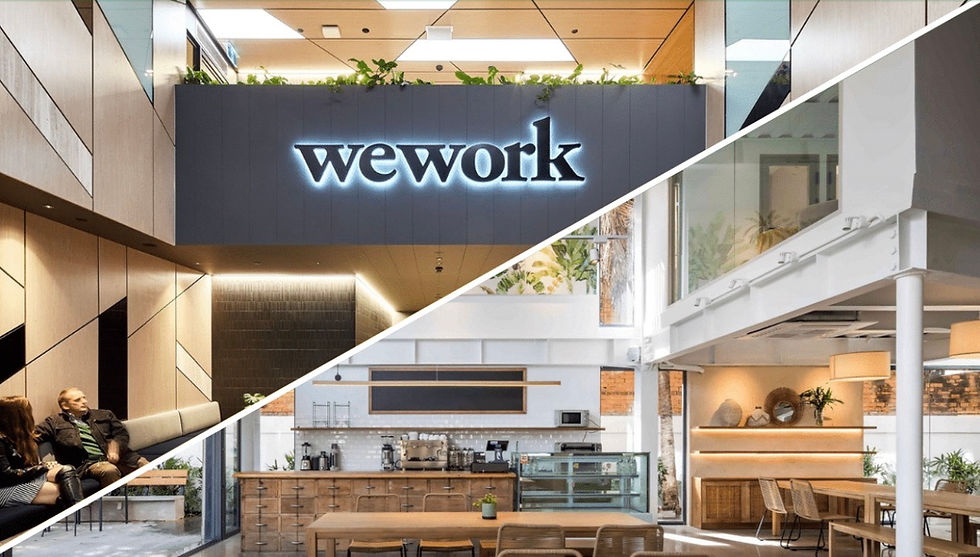
The Rise And Fall Of WeWork
In 2019, WeWork was valued at an astonishing $47 billion, hailed as the future of work and one of Silicon Valley’s most disruptive companies. Just months later, its valuation collapsed, its IPO was pulled, and its CEO was forced out. Financial disclosures revealed that WeWork reported a net loss of approximately $1.9 billion in 2018 alone, raising concerns about the sustainability of its rapid growth strategy. While financial losses and flawed business models definitely played a role, the true root of WeWork’s downfall was the leadership failure of founder Adam Neumann.
Founder syndrome
Founder syndrome usually occurs when a company’s founder has constant excessive control, rejecting criticism while believing that they know what is best. Adam Neumann embodied this idea perfectly.
Neumann was not just WeWork’s CEO: he was the company’s whole identity. His charismatic storytelling attracted investors, employees, and the media’s attention. However, this created a culture where employees were not encouraged to speak up, and proper processes were not followed. As WeWork expanded to the global market, decisions remained personality-driven and impulsive, creating enormous risks.
A charismatic vs responsible leader
Charisma is often mistaken for competence, and Neumann’s confidence helped WeWork grow rapidly. Yet, charismatic leadership without responsibility is dangerous. There are certain responsible leadership demands: financial discipline, ethical decision-making, transparency, and long-term sustainability.

At WeWork, these principles were often overlooked. There was lavish spending, questionable acquisitions, and unrealistic growth targets, claiming it was part of a “tech-powered movement” while the company’s finances were not strong. This gap between ambition and reality caused investors to lose confidence in the company. For example, the company committed to long-term leases totaling more than $47 billion while generating far lower short-term revenues, increasing the financial risk.
The agency problem in action
The agency problem happens when executives make decisions that benefit themselves instead of the shareholders. WeWork is a clear example of this. Adam Neumann personally owned buildings that WeWork leased, cashed out hundreds of millions before the IPO, and kept super-voting shares which gives holders significantly more votes and this gave him control over the company. These moves benefited him personally but created conflicts of interest and caused investors to be cautious. Prior to the failed IPO, Neumann reportedly received around $700 million through stock sales, loans, and real estate transactions involving WeWork.
Lack of Corporate Governance and Board Oversight
Corporate governance exists to prevent problems like this, but at WeWork, it was missing. The board allowed Adam Neumann to have extreme control, conducted limited financial review, and did not address conflicts of interest which are very important. Instead of acting as a check on the CEO, the board often supported his decisions. Because of this, risky actions and decisions continued until public attention forced changes but by the time that happened, WeWork’s value and reputation had already dropped significantly. Following the IPO withdrawal, WeWork’s valuation fell from $47 billion to approximately $8 billion, demonstrating the impact of weak governance and board oversight.

Lessons for future managers
WeWork’s experience highlights several important lessons for future managers that might go through a similar experience. Vision and ambition are definitely important, but they must be supported by accountability at all times. Rapid growth is not enough to sustain a company in the long term.
This case of WeWork also shows that charisma cannot replace managerial competence. While persuasive leadership can attract investors and employees, it does not guarantee effective decision-making. Successful management requires discipline, structure, and the ability to respond to financial and operational constraints.
Furthermore, strong corporate governance plays an important role in maintaining the stability of the company. Boards of directors exist to provide oversight, reduce risk, and protect the long-term interests of the company and its stakeholders.
Conclusion
WeWork’s decline was not the result of chance or unfavorable market conditions. Instead, it stemmed from leadership that operated with limited oversight, weak structures, and a high concentration of decision-making power in one individual which was the CEO. The company’s rapid rise and subsequent fall illustrates how even strong visions can fail without accountability.
By: Seungmin Woo


Comments